








































































































































































The Artemis II mission accomplished something that had not been done since 1972: sending humans beyond low Earth orbit. Launched on April 1, 2026, this historic mission marked the first crewed flight to travel toward the Moon in over 50 years. For the first time in history, a woman, a non-U.S. citizen, and a person of color journeyed to the Moon, traveling more than 230,000 miles aboard the Orion spacecraft. More than a flyby, the mission served as a critical test of the Orion spacecraft and its life-support systems. It lasted approximately 10 days before splashing down on April 10, 2026, after a total mission duration of 9 days, 1 hour, and 32 minutes, and it set the stage for future lunar landings and, ultimately, crewed missions to Mars.
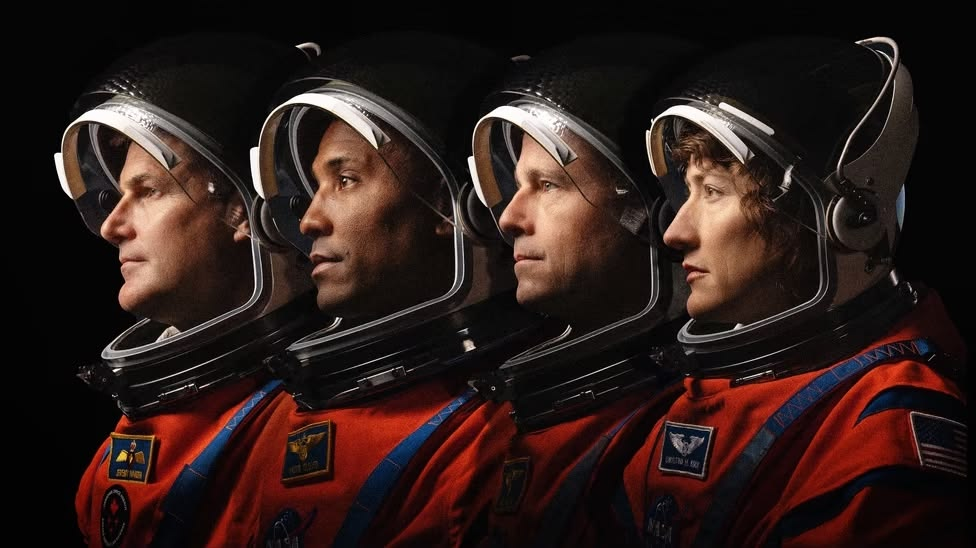
The four astronauts assigned to the mission were Reid Wiseman as Commander, Victor Glover as Pilot, and Christina Koch and Jeremy Hansen as Mission Specialists. Wiseman is a 27-year Navy veteran who was selected as a NASA astronaut in 2009 and holds degrees from Rensselaer Polytechnic Institute and Johns Hopkins University. Glover was selected as an astronaut in 2013 while serving as a Legislative Fellow in the United States Senate, and previously served as pilot of the Crew-1 Dragon spacecraft Resilience, which flew to the International Space Station, where he also served as Flight Engineer for Expedition 64/65. Koch set the record for the longest single spaceflight by a woman at 328 days and earned a Master of Science in Electrical Engineering from North Carolina State University. Hansen, a Canadian Space Agency astronaut with a Bachelor of Science in space science and a Master of Science in physics, became the first Canadian ever to venture to the Moon.
Christina Koch made history as the first woman to ever leave Earth’s orbit, traveling toward the lunar far side and continuing to inspire a new generation, not only of women but of young people everywhere. Equally moving was a personal tribute by Commander Wiseman, who named one of the Moon’s craters after his late wife Carroll, a newborn intensive care unit Registered Nurse who dedicated her life to helping others. It was an emotional moment for the crew and the world alike.
The crew’s words resonated just as powerfully as their journey. Wiseman reflected on what it means to be human in the vastness of space: “Before you launch, it feels like it’s the greatest dream on earth. And when you are out there you just wanna get back to your family and friends, it’s special to be a human and it’s a special thing to be on planet earth.” His words served as a push to appreciate the things in life that we often take for granted, and to understand that gratefulness is a meaningful trait. Hansen offered a message equally connected to the audience: “I would suggest to you that when you look up here, you’re not looking at us, we are a mirror, reflecting you.” It gave people the hope of becoming someone who could one day contribute to our societal advancements and inspire others.
Perhaps the most widely shared moment of the mission came from Victor Glover, who delivered an unscripted Easter Sunday message from 240,000 miles away. “I don’t have anything prepared,” he began. “I think these observances are important, and as we are so far from Earth and looking back at the beauty of creation, I think for me, one of the really important personal perspectives that I have up here is I can really see Earth as one thing.” He went on to describe Earth itself as a kind of spaceship, one created to give humanity a place to exist in the cosmos. “I think maybe the distance we are from you makes you think what we’re doing is special, but we’re the same distance from you. And I’m trying to tell you, just trust me, you are special. In all of this emptiness, this is a whole bunch of nothing, this thing we call the universe, you have this oasis, this beautiful place that we get to exist (in) together.” He closed by calling on people of all cultures and beliefs to remember what they share: “This is an opportunity for us to remember where we are, who we are and that we are the same thing. And that we got to get through this together.”
His speech gave a clear message: that the many conflicts we experience on Earth appear insignificant when viewed from 240,000 miles away. We are all living together on a piece of space dust we call home. The universe is part of you, and you are part of the universe. Why would the universe work against itself?
A question frequently asked has been, “Why are we going back to the Moon?” The answer is clear: because we want to see humans on Mars. NASA leadership has consistently emphasized that the Moon is our vital cosmic testbed, a place to develop and prove the systems needed for the longer journey ahead. As NASA itself stated following the splashdown, the mission “marks a key step toward a long-term return to the Moon and future missions to Mars.” The Artemis II crew understood their role in this vision. Their goal was not only to fly, it was to inspire. They want future generations to look back on this mission and see it as the beginning of something far greater.
Many people question whether governments should spend on space exploration rather than addressing problems on Earth. While this concern is understandable, missions like Artemis II drive real innovation in engineering, medicine, and communications, and inspire millions to pursue careers in science and technology. Progress requires long-term thinking. Although this crew won’t set foot on Mars, they have lit that spark in others, they have planted the question “what if” in an entire upcoming generation.
What makes Artemis II stand out is not only its technological achievement, but also the diversity of the people who flew it. Seeing a woman, a person of color, and a Canadian astronaut travel around the Moon sends a powerful message: exploration belongs to everyone. Space exploration is not about national competition or showing superiority, it is a cooperation between people working to succeed as a whole. The crew’s message focused on human connection over technology. Their words encouraged people to appreciate Earth and to recognize how small our differences appear from such a great distance. Space exploration is proof that despite political differences and conflict, we all share the same future.
Astronauts often speak of the overview effect, the shift in perspective that comes from seeing Earth from space. As Glover described it, when you look at our planet from that distance, you don’t see borders. You see one thing. The Artemis crew returned to this idea repeatedly, urging us to think less about what makes us different and more about what we have in common. It is one of the most important things space travel has to teach us.
Space travel also remains genuinely dangerous. Every astronaut who boards a spacecraft understands there is no guarantee of a safe return. The willingness of these four individuals to accept that risk for the sake of discovery, for all of humanity, is what makes their courage so admirable. Their determination inspires people everywhere to do what they’ve always feared doing.
Artemis II may also have its greatest impact not in what it accomplished, but in who it moved. Some child who watched this mission may have thought for the first time: “I want to be an engineer, a scientist, an astronaut.” Big accomplishments inspire people in ways that go beyond full understanding. Throughout history, people have crossed oceans, climbed mountains, and ventured into the unknown, driven by a desire to learn more about the world. Space exploration is the latest chapter of that same story. Artemis II demonstrates that even after decades, humanity has still so much left to explore. And they will keep reaching.
Images courtesy Josh Valcarcel/NASA