
















































































































































































THE BEAR FACTS STAFF EDITORIAL – MANY VOICES STANDING BEHIND A SINGLE MESSAGE
What do you envision when you think of the word “matriarchy?” Is it a society similar to the one found at the end of the Barbie movie where women rule and men hold inferior societal status? If so, you are in the good company of the majority of the world and pretty much every reputable dictionary on the market. But we’ve got it wrong. This “mirror-image” fallacy that projects gender reversal actually stems from patriarchal ideas that fail to grasp the true essence of a matriarchal society.
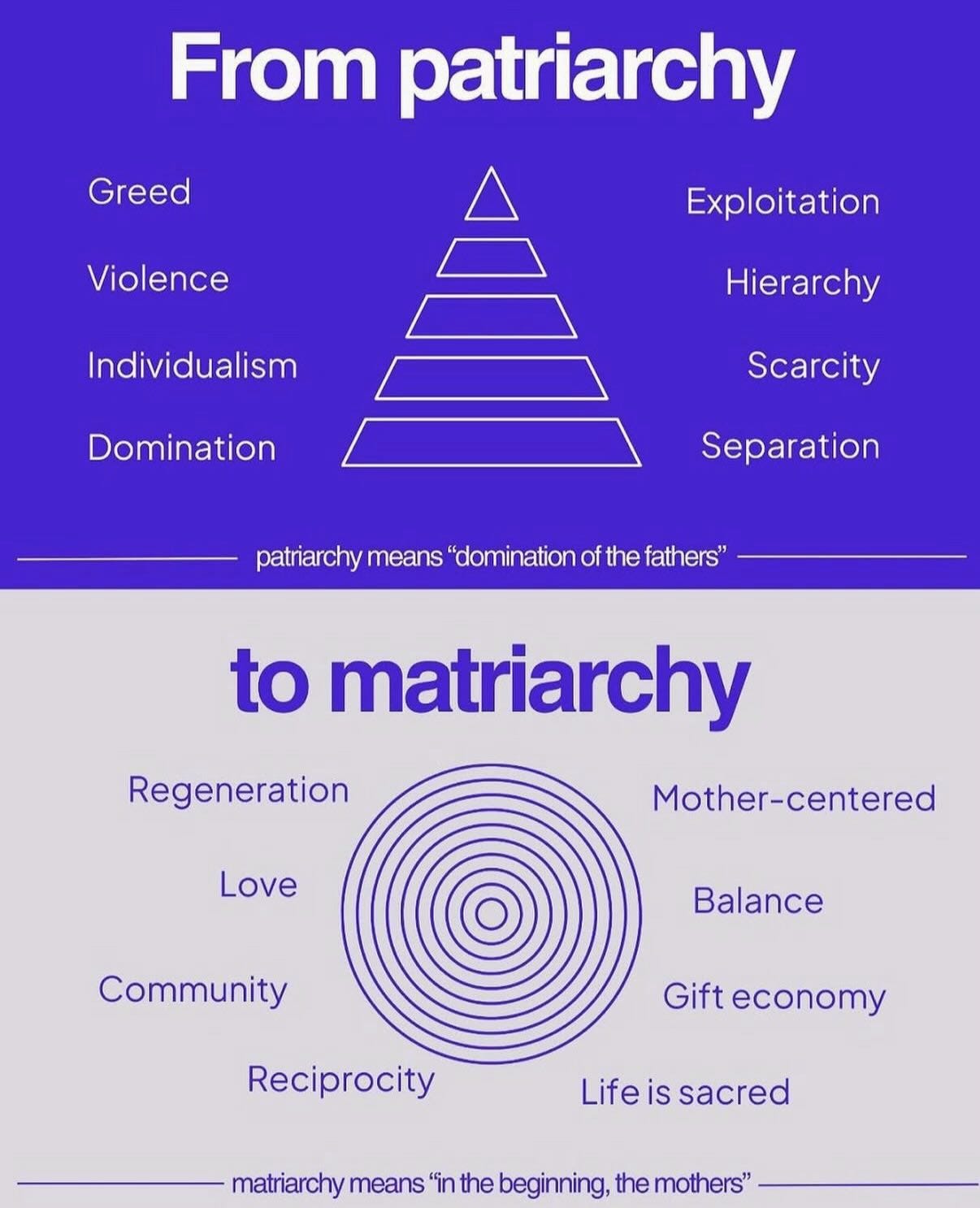
To put it simply, if gender roles were reversed and women dominated men in society, that would still be considered patriarchy. Regardless of gender, patriarchy is a scary system of government. At its core, patriarchy values hierarchy, competition, and domination above all else. Care and systems that benefit community health are devalued, violence is used as a tool to further social positioning, and power is exerted as a means to control others.
In contrast, true matriarchy is built upon consensus, responsibility, and caring. Communities do not revolve around singular rulers, but instead serve to protect their most vulnerable members: the children. By prioritizing the most needy, a matriarchal society naturally centers care-giving, sustainability, and the sharing of resources. In such a society, everyone is respected and each member’s job caters to their individual strengths, rather than personal advancement in a hierarchical, power-hungry structure. Positions of leadership are earned fairly through demonstrated talent in a given field, and leaders prioritize collective well-being and providing for all.
Our definition of matriarchy is confused because we view it through a patriarchal lens. Patriarchy is obsessed with someone being the “boss,” so we as a society assume every other system of government must have a leader, too. In the mid-1800s, Victorian European scholars living in strict patriarchies, such as Johann Jakob Bachofen and Lewis Henry Morgan, studied early civilizations and ancient cultures. They soon learned that many of these societies were matrilineal (traced family lines through the mother) and matrilocal (men moved into the woman’s home). They were so shocked to find equal treatment amongst genders and a lack of a definitive “boss,” so they labeled the societies as primitive and uncivilized, which was then allowed to justify why European white men should rule everyone. However, by defining patriarchy correctly as a system of dominance rather than simply male leadership, it is easy to see that matriarchy isn’t the opposite in terms of who rules, but is opposite in how we live.
Many people argue that patriarchy (usually in its male-dominant definition) is natural and seen throughout nature. The alpha-male ideology is applied to humans, with people arguing that males’ biologically greater strength justifies unequal leadership. However, there is a surplus of examples throughout the animal kingdom that show matriarchal societies thriving. While chimpanzees are male-dominated and violent, bonobos (who are just as closely related to humans) live in co-dominance. While females form strong bonds to keep aggression under control, no single gender rules. Bonobos solve almost all conflict through sharing, and because of a lack of competition to be at the top of a hierarchical structure, lethal violence is basically non-existent. There was also a very compelling observational study conducted by Stanford neurologist R. Sopolsky on baboons. Baboon societies are largely male-dominated and extremely aggressive. However, Sopolsky observed a particular troop that suddenly lost all its aggressive, dominant males when they contracted TB from scavenged meat (that was, of course, not shared with the vulnerable members of the troop) and died. After this, the baboon troop only contained non-aggressive males and females, and violence was observed to be dramatically reduced while social activities increased. Even when new males joined the troop over several years, they learned the non-aggressive culture. Sopolsky determined that the baboons in the troop had significantly reduced stress, which greatly benefited their health and well-being. This particular group of baboons has survived over 20 years and is known to be one of the most peaceful troops in the entire animal kingdom, proving that even in nature, animal societies don’t function well under patriarchal systems of government.
This capacity for social restructuring is not limited to our relative animals, as we can also see many examples of successful egalitarian and matriarchal societies throughout human history (about 10,000 years ago, before patriarchy was popularized). The Haudenosaunee people are a famous example, where “Clan Mothers” had the ability to nominate and impeach male chiefs, therefore creating a balance of power that allowed for an incredibly stable and successful society. Additionally, the Haudenosaunee men commonly handled diplomacy and war, while women controlled land, food supply, and ensured the most vulnerable members of society received support. This is an example of how matriarchal societies work in harmony and job positions are determined by each individual member’s strengths. Additionally, the Minangkabau valued the contributions of mothers above all else, which therefore prioritized childcare and decreased violence. The Mosuo practiced “walking marriages” with a lack of legal binding, removing the economic dependence that often leads to power-hungry patriarchal control. These societies still exist and are considered to be extremely successful, having survived colonization, globalization, and religious revolutions and wars.
Currently, our world deals with massive issues such as climate change, war, starvation, genocide, and much more. Yet, I can name numerous women that have powerful positions in governments around the world. While there is still gender discrimination, especially in certain extremist societies, it is undeniable that there is now female representation in most civilized governments. But these large issues continue to persist, and the reason is because we’re still living under patriarchy—something that increasing female representation alone can’t fix. If we stop attributing gender to the words “patriarchy” and “matriarchy,” we can begin to start seeing them for what they are: the first a dangerous system that promotes violence, hierarchy, and power, and the latter a structure that, at its heart, supports children and other vulnerable members of society by prioritizing sharing and responsibility.