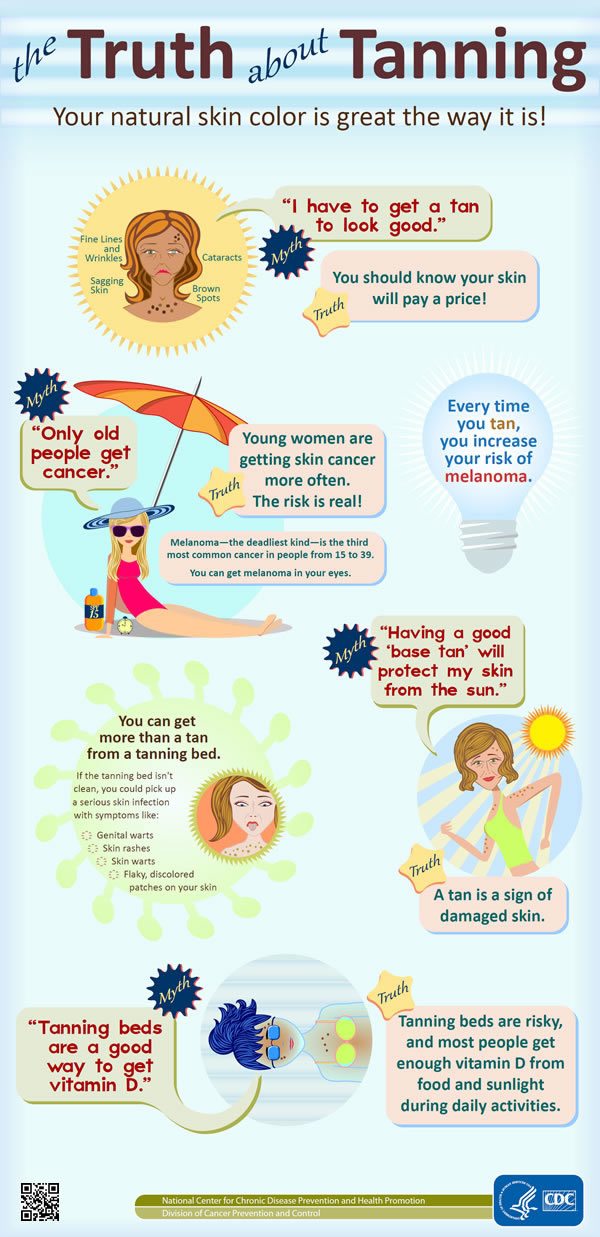














































































































































































For decades, the “healthy glow” of a sun-kissed tan has been celebrated as the ultimate symbol of a healthy, carefree lifestyle. Social media feeds are flooded with influencers lounging poolside or sunbathing at the beach, eagerly advertising their latest golden tan. Such videos often culminate with a proud showcase of extreme tan lines—the starker the contrast, the greater the achievement. Somewhere along the line, society decided that being tan equates to looking good. However, this aesthetic fixation ignores a dangerous reality: tanning is not a sign of wellness, but rather visible evidence of permanent, detrimental cellular damage.
To understand why, we have to look past the superficial appeal and examine the biological consequences of UV exposure. Most people recognize that a sunburn is bad; it’s painful, red, and generally considered a physical and aesthetic nuisance. Yet, many falsely believe that tanning is a safe alternative. While both burns and tans are bad in different ways, the main difference lies in the wavelengths of sun rays hitting the skin.
Sunburns are caused by UVB rays, which possess short, intense wavelengths that mainly hit the surface layer of the skin (the epidermis). These rays are mainly present during spring and summer months in the hours when the sun is most powerful. UVB rays directly damage DNA within cells and cause an immediate inflammatory response, producing the redness commonly associated with a bad burn. Tans, however, are caused by UVA rays. Present in equal intensity during all daylight hours year-round, UVA rays have the ability to penetrate clouds and glass. Because they have longer wavelengths, they pierce deep into the thickest layer of the skin (the dermis). Here, the rays generate highly reactive oxygen molecules known as free radicals. These particles are highly unstable and ricochet inside cells, damaging collagen, elastin, blood vessels, and DNA. A tan is merely the body’s defense mechanism; it triggers an increase in the production of melanin in a desperate attempt to prevent more genetic harm. Therefore, by the time a tan appears, cellular damage has already occurred.
DNA damage, especially when repeated, is incredibly harmful because it prevents cells from properly repairing themselves. These mutated cells can accumulate, allowing for uncontrolled, rampant cell division that causes skin cancer (melanoma). The stakes are higher than one might think: research indicates that just one blistering sunburn in childhood or five or more sunburns at any age doubles the risk of developing melanoma later in life. While the likelihood that a single tan or burn will instantly result in chronic illness is incredibly low, every instance should be treated as a warning that the skin’s defenses failed and damage has occurred.
Because UV radiation fundamentally alters DNA, the World Health Organization officially classifies exposure as a Class 1 carcinogen, putting it in the same exact risk category as cigarettes and asbestos—substances known to cause cancer in humans. Yet, while modern society heavily stigmatizes smoking, we actively encourage others to bake in the sun for hours on end.
Subsequently, several deadly misconceptions have become the product of this normalization. The first is that tanning is perfectly safe as long as you’re wearing sunscreen. While sunscreen is a vital tool, it is not 100% effective against solar radiation and does not prevent DNA damage if rays penetrate the dermis or epidermis. If a tan or burn is present after a day in the sun, it means UV radiation has overwhelmed your SPF and damaged cells.
Another pervasive misconception is that sun damage is exclusively a concern for fair-skinned individuals, or that having more natural melanin provides total protection. While higher levels of natural melanin do help absorb harmful UVB rays, therefore greatly decreasing risk of burning, melanin offers no defense against tanning. Consequently, UVA rays still reach the dermis layer of the skin regardless of complexion, causing cellular damage and accelerating premature aging, which manifests as prominent wrinkles, leathery skin texture, and hyperpigmentation.
Furthermore, we can’t ignore the lottery that is genetics. Melanoma has a strong hereditary component, and many are genetically predisposed without even knowing it. People with this particular genetic vulnerability are roughly double as likely to develop melanoma than the average individual, especially if their lifestyle revolves around chasing a tanned complexion.
Of course, we are all human, and mistakes happen. Everyone will accidentally burn or tan at some point, and no one should live indoors in a constant state of paralyzing fear because of this risk. Spending time in nature offers immense physical and mental benefits that we should all enjoy. The key to preventing serious harm is consistency in prevention: applying broad-spectrum SPF 30 or above, wearing a daily moisturizer containing sunscreen, and re-applying during periods of prolonged sun exposure. Fortunately, we also live in a time where modern alternatives to natural tanning are readily available. The beauty industry is filled with self-tanner, bronzing drops, and spray tans that result in the desired aesthetic effect without a single strand of DNA damage.
Ultimately, we as a society must make an active effort to change our collective mindset surrounding the normalization of tanning. Decades ago, smoking cigarettes was considered a glamorous, idolized social habit that many believed to be beneficial for overall health. It required aggressive education, rigorous public health campaigns, and a massive cultural shift to de-normalize smoking, emphasizing it as the deadly addiction it is. If the World Health Organization classifies tanning in the same light, it’s time we start treating it with equal gravity. For the sake of our long-term health, society must start recognizing tans as the visible evidence of DNA damage that they are, and finally leave them behind.